

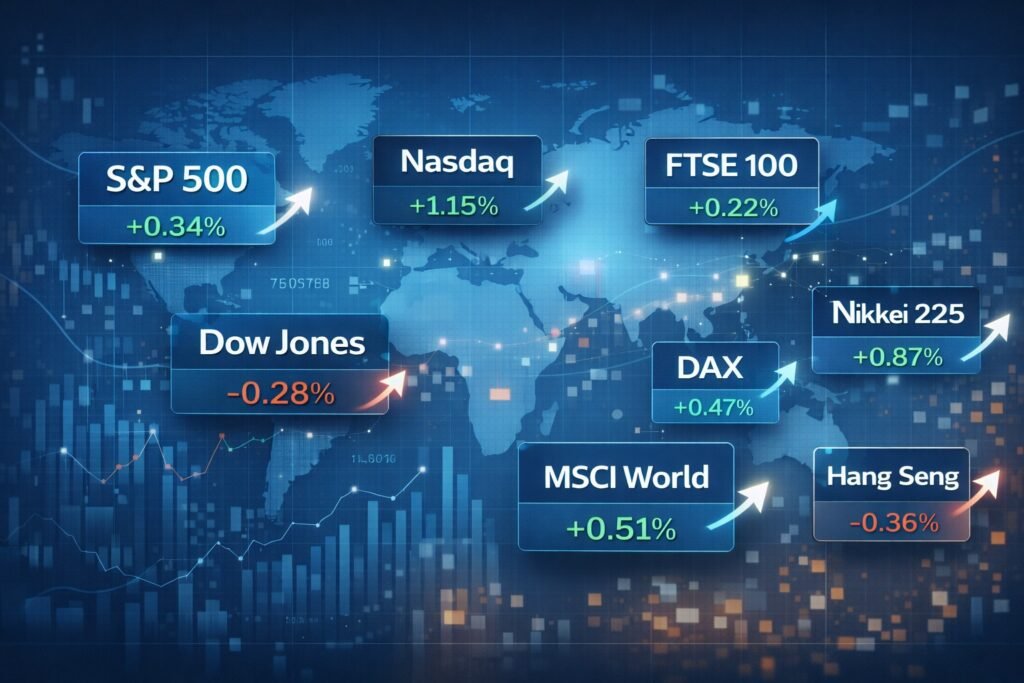
1) What is an index?
A stock market index is a benchmark that tracks the performance of a group of stocks. Instead of looking at a single company’s share price, an index combines many companies into one number (and chart) that represents a market, a country, a sector, or a style of investing (like “large caps” or “tech”).
When people say “the market is up today,” they often mean a major index like the S&P 500 in the US or the FTSE 100 in the UK rose. Indices help simplify a huge market into something measurable.
Indices are created and maintained by index providers (for example, S&P Dow Jones Indices, FTSE Russell, MSCI, STOXX). They set the rules for what gets included, how it’s weighted, and when it’s rebalanced.
2) What does it include (and exclude)?
What an index includes depends on its purpose and rulebook. Common inclusion factors:
- Country/region listing rules (where companies are listed)
- Market size (large-cap vs small-cap)
- Liquidity (shares must trade actively)
- Free float (shares available to the public)
- Sector focus (technology, energy, banks, etc.)
Common exclusions:
- Companies that don’t meet liquidity/free-float rules
- Some share classes (depending on index rules)
- Newly listed firms until they meet minimum trading history
- Firms that move exchanges or fail eligibility criteria
Important: an index is not “every company in the country.” Most popular indices represent a slice of the market (often the biggest companies).
3) How it’s calculated (price-weighted vs market-cap-weighted, etc.)
The main index weighting methods:
Market-cap weighted (most common)
Each company’s influence is based on its market capitalisation (share price × shares outstanding), often adjusted for free float.
- Pros: reflects the real market size; widely used for benchmarks.
- Cons: large companies dominate; if the biggest firms surge, the index can rise even if most stocks fall.
Examples: S&P 500, Nasdaq Composite, FTSE 100, DAX (with rules), MSCI World.
Price-weighted
Companies with higher share prices have more influence, regardless of company size.
- Pros: simple history.
- Cons: can be misleading; share price alone doesn’t reflect size.
Example: Dow Jones Industrial Average (DJIA).
Equal-weighted
Each company gets the same weight.
- Pros: reduces dominance of mega-caps; shows “average stock” performance.
- Cons: higher turnover and rebalancing; can behave differently from standard benchmarks.
Example: equal-weight versions of the S&P 500 exist.
Factor/style indices (value, growth, quality, momentum)
Weights are based on factors rather than market cap.
- Pros: targeted exposure.
- Cons: can underperform for long periods; more complex.
Capped or modified weights
Some indices cap single-stock weights or adjust to avoid extreme concentration.
4) What moves the index day to day
Indices move because their component stocks move. Common drivers:
- Company earnings and guidance (especially big constituents)
- Interest rates and bond yields (valuation impact)
- Inflation data and central bank expectations
- Currency moves (especially for global earners)
- Commodities (energy/materials-heavy indices)
- Geopolitical news (risk appetite changes)
- Sector rotation (money flows between industries)
- Index rebalancing (short-term flows when constituents change)
A key point: headlines often say “the index rose on X,” but really it’s the weighted movement of dozens or hundreds of stocks responding to changing expectations.
5) Why people track it (benchmarking, sentiment, economy)
Indices matter because they’re used as:
- Benchmarks: Funds and investors compare performance to an index.
- Market sentiment indicators: A quick read on “risk on” vs “risk off.”
- Economic signals: Not perfect, but markets reflect expectations for growth and profits.
- Portfolio building blocks: Many people use index funds/ETFs to track them.
- Media shorthand: They simplify complex markets for reporting.
6) Common misconceptions
- “An index = the whole economy.” Not necessarily. Indices reflect listed firms, often large and global.
- “If the index is up, most stocks are up.” Not always. Mega-caps can lift an index while many stocks fall.
- “All indices are calculated the same.” Weighting rules vary a lot.
- “Rebalancing is manipulation.” It’s usually rule-based maintenance.
- “A low share price means a stock is smaller.” Market cap matters, not share price.
7) Major stock market indices
These are the benchmarks you’ll see most often in stock market news.
United States
- S&P 500 – large US companies; widely used as a benchmark for US equities
- Nasdaq Composite – tech-heavy index; more growth-oriented
- Dow Jones Industrial Average (Dow) – 30 large US companies; more traditional benchmark
- Russell 2000 – smaller US companies (small-caps)
United Kingdom
- FTSE 100 – 100 largest UK-listed companies by market cap (many global earners)
- FTSE 250 – mid-sized UK companies; often more UK-economy sensitive
- AIM – smaller growth companies market (higher risk profile)
Europe
- DAX (Germany) – major German listed companies
- CAC 40 (France) – major French listed companies
- EURO STOXX 50 – 50 large Eurozone companies
Asia-Pacific
- Nikkei 225 (Japan) – major Japanese companies
- TOPIX (Japan) – broader Japanese market index
- Hang Seng (Hong Kong) – major Hong Kong listed companies
- Shanghai Composite (China) – broad index of Shanghai-listed shares
- CSI 300 (China) – large A-shares from Shanghai and Shenzhen
- ASX 200 (Australia) – major Australian companies
- KOSPI (South Korea) – major Korean listed companies
- Nifty 50 (India) – major Indian listed companies
Global / Thematic
- MSCI World – developed markets global index
- MSCI Emerging Markets – emerging markets benchmark
- Sector indices – tech, energy, financials, healthcare, etc.
If you would like to track the stock market indices live please go to https://maximisefinance.com/market-tracker/ and press on indices and select the Indice you want.
If you want to see all major indices across the world, check them out here: https://uk.investing.com/indices/major-indices
8) Quick glossary
- Market cap: Company size = price × shares.
- Free float: Shares available to public investors.
- Constituents: The stocks inside an index.
- Rebalance: Adjust weights periodically.
- Reconstitution: Change constituents based on rules.
- Benchmark: Standard used to compare performance.
- ETF/index fund: Products that track an index.
Thank you for reading the MaximiseFinance guide on stock market, if you want to know the latest news of whats happening in the stock market please go to https://maximisefinance.com/category/news/stock-market/






















6 Responses