

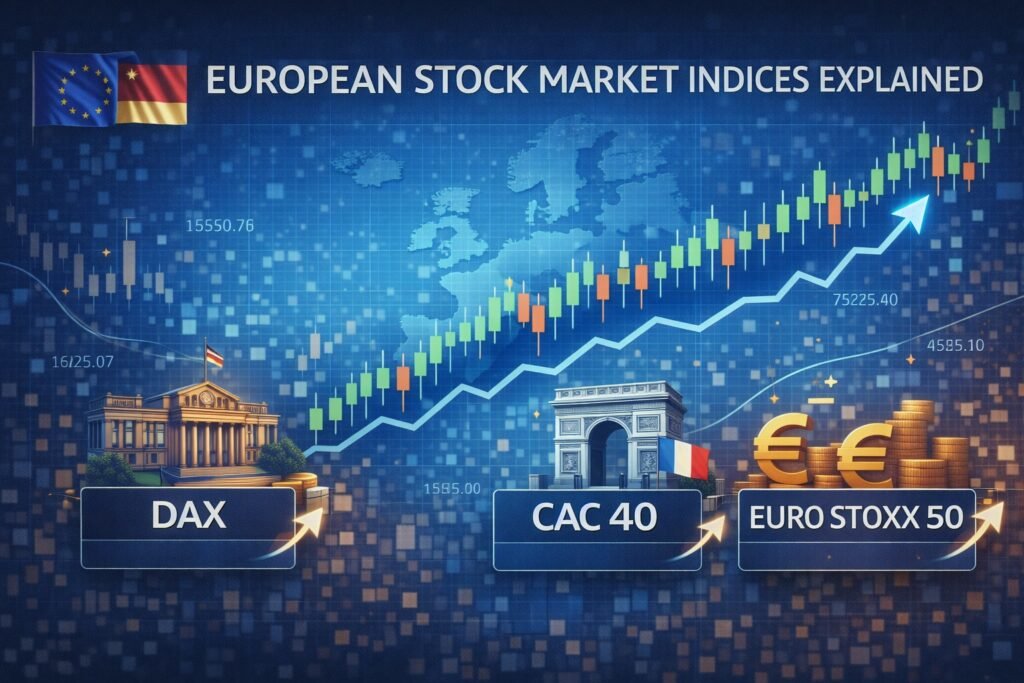
1) What is the European Index?
European stock market indices are benchmarks that track the performance of leading publicly listed companies across key European markets. They’re used to summarise market sentiment, compare Europe’s performance with other regions, and understand how European companies respond to changes in growth expectations, inflation, interest rates, and global demand.
The three most widely referenced European benchmarks are:
- DAX (Germany) — a flagship index for major German companies.
- CAC 40 (France) — a key benchmark for leading French companies.
- EURO STOXX 50 — a Eurozone-wide benchmark tracking large companies across multiple euro-using countries.
Although people often say these indices represent “Europe,” they represent different slices of it. The DAX and CAC 40 are country indices, while the EURO STOXX 50 is a cross-country index focused on the Eurozone’s largest companies. To understand Europe more broadly, it’s also useful to look at wider benchmarks like the STOXX Europe 600 (more on that below).
2) What does it include (and exclude)?
Each index has a rulebook defining eligibility. These rules typically cover market size, liquidity (how easily shares can be traded), free float (shares available to the public), and listing requirements.
DAX (Germany)
The DAX includes major German blue-chip companies that meet eligibility standards. Germany’s market is known for globally competitive exporters and industrial strength, so the DAX often has meaningful exposure to businesses connected to:
- manufacturing and engineering
- industrial technology and automation
- chemicals and materials
- consumer and healthcare leaders with international revenue
Excludes: smaller German companies that don’t meet size/liquidity thresholds and companies outside the eligibility rules.
CAC 40 (France)
The CAC 40 tracks 40 large, influential French companies. France’s benchmark often includes:
- global consumer and luxury-linked names
- industrial and infrastructure-linked firms
- large financial and healthcare businesses
Many CAC 40 constituents generate significant revenue outside France.
Excludes: smaller French firms and companies failing free-float/liquidity rules.
EURO STOXX 50 (Eurozone)
The EURO STOXX 50 tracks 50 of the largest companies across the Eurozone. It’s a common headline gauge of Eurozone large caps and is used widely in funds and market commentary.
Includes: large companies across multiple euro-using countries (composition changes over time as constituents are reviewed).
Excludes:
- companies from European countries outside the Eurozone (for example, the UK and Switzerland) because it’s Eurozone-focused
- smaller Eurozone companies (it’s large-cap by design)
- firms failing liquidity/free-float requirements
3) How it’s calculated (price-weighted vs market-cap-weighted, etc.)
European indices are generally free-float market-cap weighted, meaning:
- larger companies have a bigger influence on index movement
- weights are adjusted for free float, so shares available to public investors count more than restricted or insider-held shares
This matters because index performance can become concentrated. A small number of large stocks can drive returns, even if the average constituent isn’t moving much. That’s one reason it helps to compare large-cap indices (like EURO STOXX 50) with broader indices (like STOXX Europe 600) to understand whether gains are broad-based or narrow.
Indices are also reviewed periodically:
- rebalancing adjusts weights
- reconstitution can change constituents if eligibility rules are no longer met
4) What moves the index day to day
European indices move as their constituents reprice based on expectations about earnings, rates, inflation, and risk. Europe has some distinctive sensitivities that can make it behave differently from the US.
ECB policy and interest rates
The European Central Bank (ECB) influences:
- borrowing costs across the Eurozone
- valuation levels (how much investors are willing to pay for earnings)
- the outlook for banks (rate changes can alter lending margins and credit demand)
Even when rates don’t change, shifts in tone (more concerned about inflation vs more focused on growth) can move markets.
Inflation and energy sensitivity
Europe can be especially sensitive to energy because energy prices feed into:
- household inflation and real spending power
- corporate input costs and margins
- expectations for central bank policy
Large swings in oil and gas prices can therefore affect both earnings expectations and valuation expectations.
Export demand and global trade cycles
Europe, and Germany in particular, has many globally exposed exporters. Global demand for industrial goods, machinery, autos and components, and chemicals can influence earnings expectations. When global growth expectations improve, European industrial-heavy segments can benefit; when global trade slows, the opposite can happen.
Currency moves (EUR)
The euro affects:
- exporters’ competitiveness
- translated earnings for global firms
- inflation through import prices
A weaker euro can support exporters but also raise import-driven inflation, which can feed back into policy expectations.
Sector leadership and composition
Sector weights differ vs the US. Depending on the index, Europe can be more influenced by:
- banks and financials
- industrials and materials
- luxury/consumer global brands
- healthcare defensives
This sector mix helps explain why Europe may underperform during US mega-cap tech-led rallies, or outperform when cyclicals and value sectors lead.
Geopolitics and regulation
Trade policy, sanctions, and regulatory shifts can matter. Europe also has periods where political uncertainty can influence risk premiums, especially when investors worry about fiscal policy, energy security, or growth outlooks.
5) Why people track it (benchmarking, sentiment, economy)
European indices matter because they’re widely used as:
- benchmarks for European equity funds and portfolios
- a sentiment gauge for regional risk appetite
- a way to interpret policy expectations (especially around the ECB)
- a tool for regional diversification versus the US and Asia
While these indices are not the same as the economy, they do reflect the market’s expectations about future profits, which are influenced by growth, inflation, and credit conditions.
6) Common misconceptions
“EURO STOXX 50 represents all of Europe.”
It doesn’t. It’s Eurozone large caps only.
“Country indices are mainly driven by domestic demand.”
Not always. Many constituents earn globally, so worldwide demand and currency can matter as much as local data.
“Europe always underperforms the US.”
Not guaranteed. Sector mix, valuations, currency trends, and the stage of the cycle all matter.
“Currency doesn’t matter.”
Currency can affect exporters, imported inflation, and reported earnings.
“If the index is up, most stocks are up.”
Market-cap weighting can allow a few large stocks to drive index performance even when breadth is mixed.
7) Related indices + related reading (with comparisons + more Europe-focused indices)
To understand European markets properly, it helps to look beyond the big three benchmarks above and add broader regional measures, cross-region comparisons, and additional country “lenses.” These also make excellent internal link targets and future “Index Explained” pages.
Broader Europe (more breadth)
STOXX Europe 600 (STOXX 600)
One of the most widely followed benchmarks for European equities because it covers large, mid, and small-cap companies across multiple European markets. Compared with large-cap-only indices, it often provides a more representative picture of how “Europe overall” is performing.
Why STOXX 600 is valuable alongside DAX/CAC/EURO STOXX 50:
- Breadth: includes many more companies than the EURO STOXX 50, so it can reflect what’s happening beyond mega-caps.
- Regional view: covers multiple European markets, not just the Eurozone’s biggest names.
- Market breadth signal: if the EURO STOXX 50 is rising but STOXX 600 is flat, it may indicate gains are concentrated in a small group of large stocks.
- Sector insight: broader coverage helps identify whether performance is being driven by financials, industrials, healthcare, consumer sectors, or energy.
Cross-region comparisons (how to compare Europe vs UK vs US)
FTSE 100 / FTSE 250 (UK)
- FTSE 100 often behaves like a “global earnings” index because many constituents earn overseas. It can sometimes benefit when GBP weakens (overseas revenue translates into more GBP).
- FTSE 250 is often more UK-domestic sensitive (consumer spending, housing, UK rates).
How to use the comparison:
- If Europe is weak but FTSE 100 is steady, it may be currency/commodity/sector mix.
- If FTSE 250 lags, it can signal UK domestic pressure even if broader Europe is stable.
S&P 500 (US)
The key global benchmark for US large caps and a reference point for global risk appetite.
How to use the comparison:
- If the S&P 500 rises mainly due to mega-cap tech while Europe is flat, it’s often sector composition and rate sensitivity.
- If Europe sells off on ECB or energy/inflation concerns while the S&P 500 holds up, it’s often regional policy/energy sensitivity.
MSCI World
A developed-markets benchmark used to compare Europe to the broader developed world, not just one country.
How to use the comparison:
- If Europe underperforms MSCI World, it may reflect weaker growth expectations, sector mix differences, or higher perceived risk.
- If Europe outperforms MSCI World, it can reflect valuation catch-up, cyclical leadership, or improving policy/earnings expectations.
More Europe-focused indices (additional “country lens” pages)
If you want deeper Europe coverage (and strong SEO supporting pages), these are solid additions:
STOXX Europe 50
A large-cap European benchmark that can act as a “European mega-cap” comparison that isn’t limited to the Eurozone in the same way as EURO STOXX 50 (depending on index definitions and coverage used).
FTSE MIB (Italy)
Italy’s main large-cap index. It is often discussed in the context of:
- Eurozone sentiment
- domestic fiscal/political developments
- banking and credit conditions
It can react strongly when investors become sensitive to borrowing costs and perceived regional risk.
IBEX 35 (Spain)
Spain’s main large-cap index. It is frequently referenced for exposure to:
- banks and financial conditions
- utilities and regulated sectors
- domestic growth expectations
It can respond quickly to shifts in rate expectations and credit conditions.
AEX (Netherlands)
A key Dutch index that can be a useful lens for internationally exposed European businesses and sector leadership differences within Europe.
SMI (Switzerland) (Europe-focused but outside the Eurozone)
A major Swiss index often used as a “defensive Europe” lens depending on constituents and sector mix. Helpful for comparing Eurozone cyclicality vs Swiss stability.
OMX Stockholm 30 (Sweden) (Europe-focused, outside the Eurozone)
A Nordic index that can act as a lens on European cyclicals, industrial exposure, and risk sentiment in non-euro European markets.
8) Quick glossary
- ECB: European Central Bank, sets policy for the Eurozone.
- Eurozone: countries using the euro.
- Free float: shares available to public investors.
- Market-cap weighted: bigger companies influence the index more.
- Sector concentration: index dominated by a few sectors or mega-caps.
- Export exposure: dependence on global demand and overseas revenue.
- Earnings translation: currency changes affecting reported profits.
- Breadth: how many stocks rise vs fall within an index.
Thanks for reading the MaximiseFinance guide on European stock market indices, if you want to read the Indices Fully Explained guide in depth and how they work, please click below






















2 Responses