

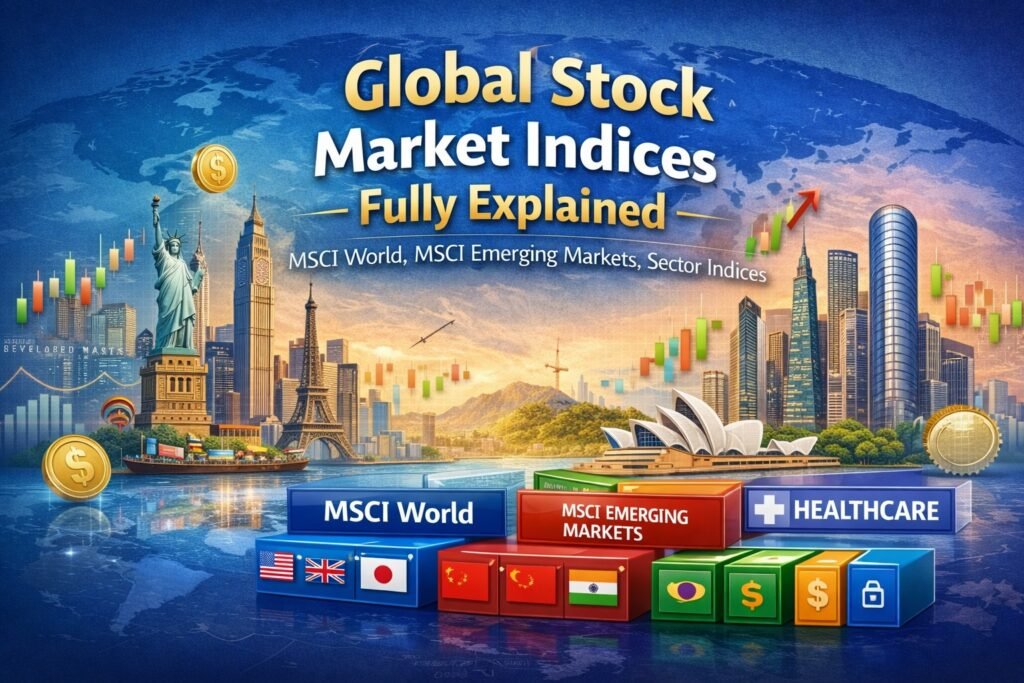
1) What is the Global Stock Market Index?
Global stock market indices are benchmarks that track share market performance across many countries, helping investors measure “world equity” performance rather than any single market. They’re widely used by professionals and everyday investors to benchmark portfolios, compare regions, and build diversified exposure through index funds and ETFs.
Two of the most commonly referenced global benchmarks are:
- MSCI World (developed markets)
- MSCI Emerging Markets (emerging markets)
Alongside these, sector indices track industries across regions (technology, energy, financials, healthcare, consumer, industrials, and more). Sector indices are useful when you want thematic exposure (for example “global technology”) rather than geographic exposure (for example “US stocks” or “Europe stocks”).
A key idea: global indices are rules-based baskets. They are not “the entire world economy,” and they’re not evenly spread across every country. They reflect the parts of the world that are publicly listed and investable under the index provider’s rules.
2) What does it include (and exclude)?
Global indices follow a rulebook that defines which markets and which companies qualify. Most global benchmarks use criteria like:
- Market size (typically large and mid caps)
- Liquidity (shares must trade reliably)
- Free float (shares available to public investors)
- Market classification (developed vs emerging)
MSCI World
Includes: large and mid-cap companies across developed markets (for example, North America, parts of Europe, and developed Asia-Pacific).
Excludes: emerging markets by design. It also excludes many small-cap companies because it focuses on large/mid caps.
Why that matters: MSCI World is often used as a “global developed markets” baseline, but it won’t capture emerging economies unless you add a separate EM benchmark.
MSCI Emerging Markets
Includes: large and mid-cap companies across emerging economies.
Excludes: developed markets (by definition) and, depending on the index scope, many smaller companies and names that fail liquidity/free-float requirements.
Important detail: “emerging markets” classification can change over time as countries develop, markets open, or index providers update their framework. That means the country mix in EM indices can evolve.
Sector indices
Includes: companies based on sector classification systems (for example, “technology,” “energy,” “financials,” “healthcare,” etc.).
Excludes: companies outside the chosen sector classification, even if they feel “tech-adjacent” or “energy-adjacent.” Classification is rule-based, so a company’s inclusion depends on the provider’s definitions.
Typical exclusions across global and sector indices:
- Companies below size and liquidity thresholds
- Firms with insufficient free float
- Countries outside the developed/emerging classification for that index
- Markets with restrictions that limit investability (depending on rules)
3) How it’s calculated (price-weighted vs market-cap-weighted, etc.)
Most global indices are free-float market-cap weighted, meaning:
- Larger companies have more influence on index moves
- Large markets can dominate the index
- Concentration can rise when mega-caps outperform
Why market-cap weighting changes what you’re “actually tracking”
Market-cap weighting is popular because it reflects the market’s total investable value. But it also creates concentration:
- If a handful of mega-cap firms surge, the index can rise even if many smaller constituents are flat.
- If one country has a much larger market than others, it will occupy a bigger share of the index.
Sector indices: often market-cap weighted too
Most sector indices are also market-cap weighted. That can make them “top-heavy”:
- A small number of giant firms can drive most performance in “global tech,” for example.
- The index can become less diversified than it appears from the name alone.
Some providers offer equal-weight or capped alternatives, but the standard versions are usually market-cap weighted unless stated otherwise.
4) What moves the index day to day
Global indices respond to global expectations. Key drivers include:
US performance and interest rates
The US often has a large weight in developed market indices, so US equity moves and US rate expectations can heavily influence “global” benchmarks. Higher yields can pressure valuations globally, especially growth-heavy exposures.
Global inflation and central bank shifts
When markets expect tighter policy (higher rates for longer), equities can reprice lower. When markets expect easing or improving inflation trends, risk appetite can rise. This dynamic can show up across global indices at once.
USD strength and currency translation
The US dollar can influence global returns through:
- Earnings translation for multinationals
- Capital flows into and out of emerging markets
- Debt/funding conditions for countries and companies that borrow in dollars
Commodities (especially for emerging markets and resource-heavy countries)
Commodity prices can meaningfully affect:
- Countries reliant on commodity exports
- Inflation trends
- Corporate margins in energy/materials-heavy markets
That’s why global and EM indices can move with energy and metals cycles.
Global growth expectations (trade and manufacturing)
Global indices tend to be sensitive to:
- trade volumes
- manufacturing and supply chain conditions
- consumer demand trends
When global growth expectations improve, cyclicals and exporters often benefit.
Geopolitical risk
Heightened uncertainty can push investors toward safety (“risk-off”), impacting global indices. Trade restrictions and supply chain disruptions can also shift sector and country performance.
Sector leadership
Even in a “global” index, returns can be driven by the sectors that dominate the weighting at the time. In some periods, technology leadership has been a major driver of developed-market performance; in other periods, energy, financials, or industrials lead.
5) Why people track it (benchmarking, sentiment, economy)
Global indices matter because they are widely used as:
- Benchmarks: Global funds often measure performance against MSCI World, MSCI EM, or similar baselines.
- Diversification tools: They offer exposure across countries and industries, reducing reliance on a single market.
- Sentiment indicators: They provide a broad read on risk appetite and market confidence.
- Portfolio building blocks: Many long-term portfolios use global indices as a core allocation, then add tilts (regions, sectors, style factors) around them.
- Context for headlines: They help answer, “Is this move local or global?”
6) Common misconceptions
“Global means evenly distributed.”
It doesn’t. Market-cap weighting can concentrate exposure in a few large markets and a small number of mega-companies.
“Emerging markets always outperform.”
Higher growth potential doesn’t guarantee better returns. Currency volatility, political risk, governance differences, and funding conditions can matter as much as growth.
“Sector indices are automatically diversified.”
A sector index can be heavily concentrated in a handful of giants. “Global tech” can still be dominated by a small number of companies.
“If the global index is up, every region is up.”
Not true. A few large markets or sectors can lift the headline while other regions lag or fall.
“MSCI World = the whole world.”
MSCI World is developed markets only. It excludes emerging markets by design.
7) Related indices + Comparisons
Sector indices
Sector indices are powerful supporting content because they explain leadership cycles:
- Technology sector indices: Often sensitive to rates, growth expectations, and innovation cycles.
- Energy sector indices: Sensitive to oil/gas prices, geopolitics, and supply-demand shocks.
- Financials sector indices: Sensitive to yield curves, credit conditions, and regulation.
- Healthcare sector indices: Often defensive; sensitive to policy and innovation cycles.
- Consumer sector indices (staples/discretionary): Tied to spending power, inflation, and confidence.
- Industrials sector indices: Sensitive to manufacturing cycles, trade, and infrastructure demand.
Cross-index comparison
1) MSCI World vs S&P 500 (is the “global” move US-led?)
- If S&P 500 is outperforming MSCI World, it often suggests the rally is US-led (or concentrated in US mega-caps), while other developed markets are lagging.
- If MSCI World is outperforming the S&P 500, it can indicate broader developed-market strength outside the US (often Europe or Japan contributing more), or less concentration in US mega-caps.
- If both move in the same direction, it usually points to a global macro driver (rates, inflation expectations, risk sentiment) rather than a region-specific story.
2) MSCI Emerging Markets vs MSCI World (is risk appetite shifting?)
- If MSCI EM is outperforming MSCI World, it often signals stronger risk appetite and a market willing to take on higher-volatility exposure, sometimes helped by a weaker USD or improving global growth expectations.
- If MSCI EM is underperforming MSCI World, it often suggests a risk-off tone, tighter global financial conditions, or EM-specific pressures like currency weakness, commodity swings, or policy uncertainty.
- If EM performance flips quickly, it can reflect capital flow sensitivity, EM often reacts faster to changes in US rates and the dollar.
3) Sector indices vs MSCI World (what’s actually driving returns?)
- If global tech sector indices outperform MSCI World, it often means the market is being driven by growth leadership (often rate expectations, AI/innovation themes, or strong earnings from large tech names).
- If global energy sector indices outperform MSCI World, it often points to an oil/gas-driven market (supply shocks, geopolitical risk, or inflation pressures affecting energy prices).
- If defensive sectors (healthcare, staples, utilities) outperform MSCI World, it can signal risk-off positioning and preference for stability over growth.
- If many sectors move broadly in line with MSCI World, it suggests broad-based participation (healthier market breadth) rather than returns being concentrated in a single theme.
8) Quick glossary
- Developed markets: established economies with mature, widely accessible financial markets.
- Emerging markets: developing economies with potentially higher growth but higher volatility and policy/currency risk.
- Country weight: the share of an index represented by a given country (can be concentrated).
- Sector classification: rules used to group companies into industries (varies by provider).
- Concentration risk: heavy reliance on a few large constituents or one dominant country/sector.
- Free float: shares available to public investors (used in weighting).
- Capital flows: movement of investor money across countries/regions, often driven by rates and risk sentiment.






















2 Responses